Company information. Shaping the Inside of Glass
Femtika is a Lithuania-based manufacturer developing femtosecond laser machines for transparent materials micro-fabrication. Our technology, based on Selective Laser-Induced Etching (SLE), enables complex 2D and 3D microstructures from glass and other transparent materials. Femtika serves science and industry across biotech, semiconductors, photonics, watchmaking, and many other sectors worldwide.
The Limits of Conventional Transparent Materials Processing
Developing true 3D structures from transparent materials is one of the most demanding tasks in modern manufacturing. Processing methods such as drilling, CNC machining, moulding, chemical etching, ultrasonic machining, photolithography with etching, laser ablation, and conventional CO2 or UV laser cutting each come with their own limitations:
- Limited material capability — few materials match glass for thermal resistance, chemical resistance, transparency, and bio-compatibility combined. Yet many industries don’t realize glass can be processed exactly the way they need it.
- Mechanical stress and cracking — many processing methods apply physical force that risks fracturing transparent materials and usually can’t reach micron scale precision required.
- Surface-only processing — photolithography with etching and moulding can shape exterior surfaces with high resolution. But they can’t create internal channels, embedded structures, or free-form 3D geometries — that shape freedom remains expensive, hard to scale, or simply not possible.
- Limited depth and aspect ratio — photolithography works great at flat, layered patterns but struggles with deep, high-aspect-ratio 3D features — while laser cutting and ablation generate heat that can melt, distort, or crack the material.
- Hard to adapt and scale — achieving consistent results requires months of selecting the right parameters, significant resource allocation, and considerable time to understand and implement, slowing time-to-result for R&D teams and manufacturers
These limitations hold back the adoption, development, and scaling of technologies that advanced industries need today. And the demand will only grow as future innovations increasingly depend on transparent micro-components.
Turning SLE into a Production-Ready Process
We provide access to a technological solution that solves these challenges. It turns Selective Laser-Induced Etching (SLE) from a research-lab technique into a production-ready process. Capabilities that were once hard to access are now available to science and industry — through both machines and contract manufacturing services.
The process starts with understanding the customer’s application and adapting the required part to SLE process. Then, we develop a tailored laser “recipe” — the exact combination of laser settings and etching parameters needed for repeatable, production-ready results.
Once that process is proven, customers can acquire a machine to bring production in-house and scale it. Or they can rely on Femtika’s contract manufacturing service until they’re ready to produce parts themselves.
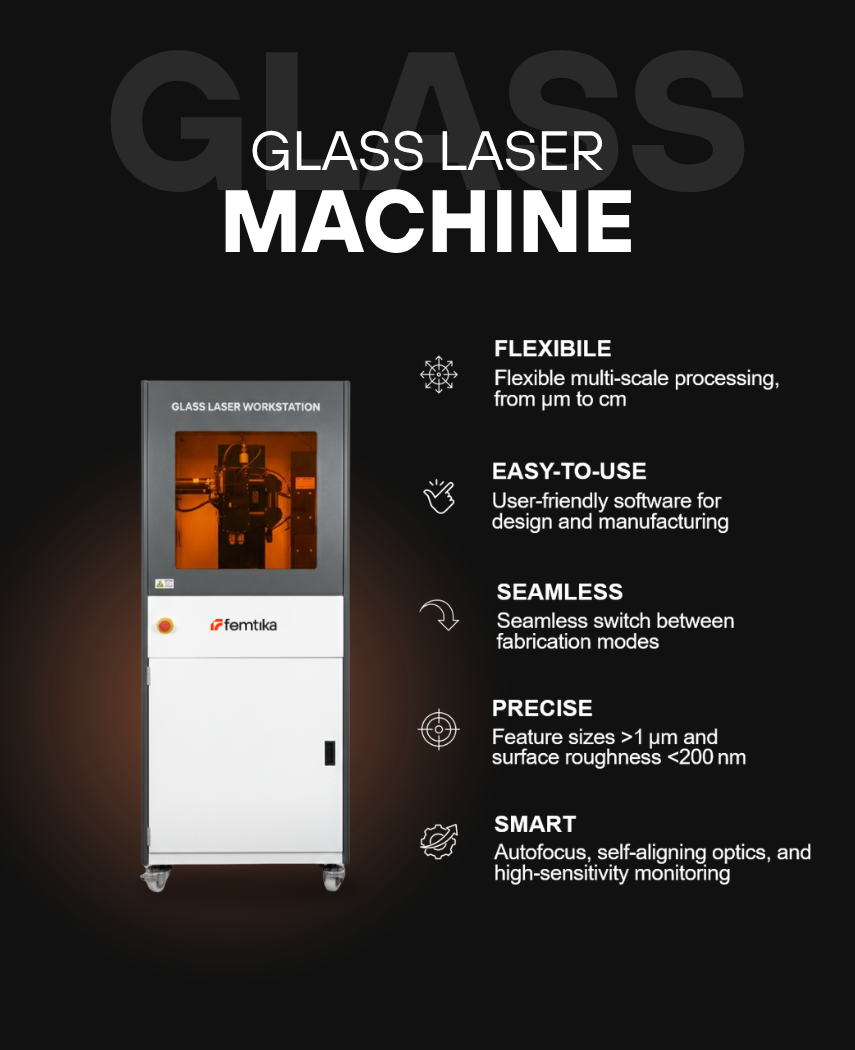
Glass Laser Machine — built for industrial and standardised production of transparent materials, easy to use, adapted for non-photonics users, and ready for micro-parts production.
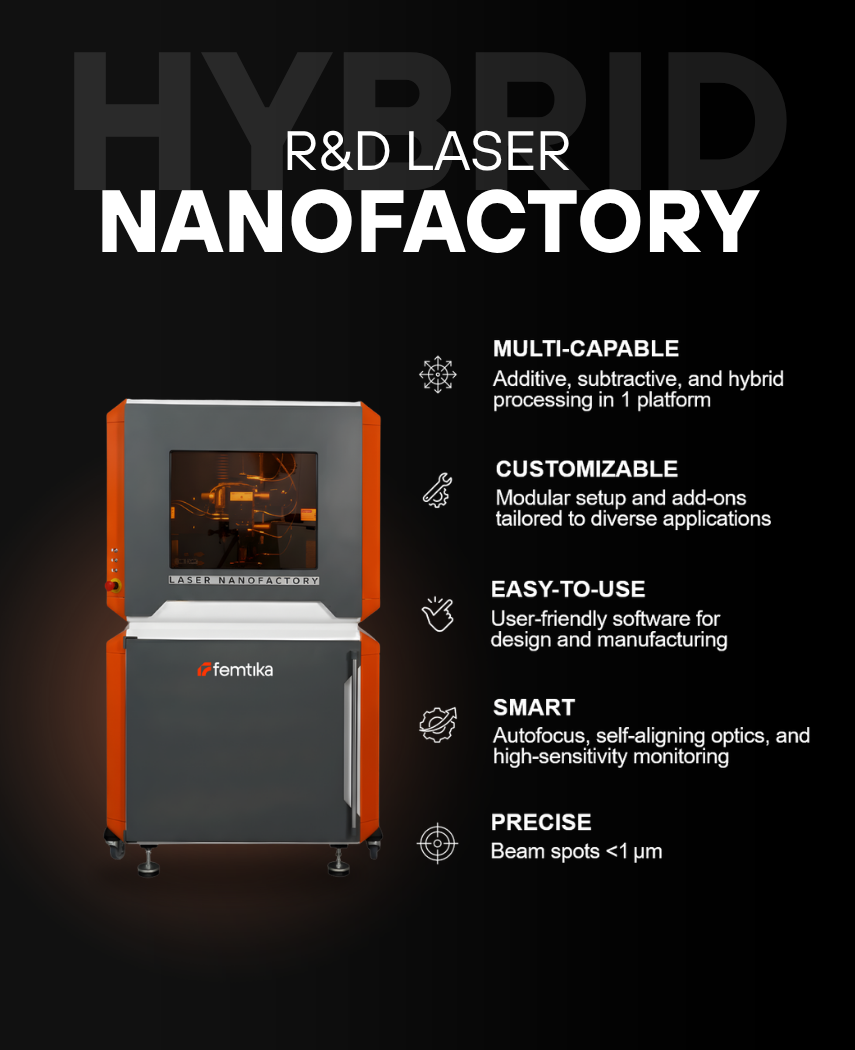
Laser Nanofactory — a hybrid machine combining SLE with multiphoton polymerization (MPP, also known as two-photon polymerization) and other laser processes, designed for organisations that also need to process polymers at the micro-scale. Rather than investing in separate systems for each technique, R&D teams get one platform built for scientific research and small-scale production.
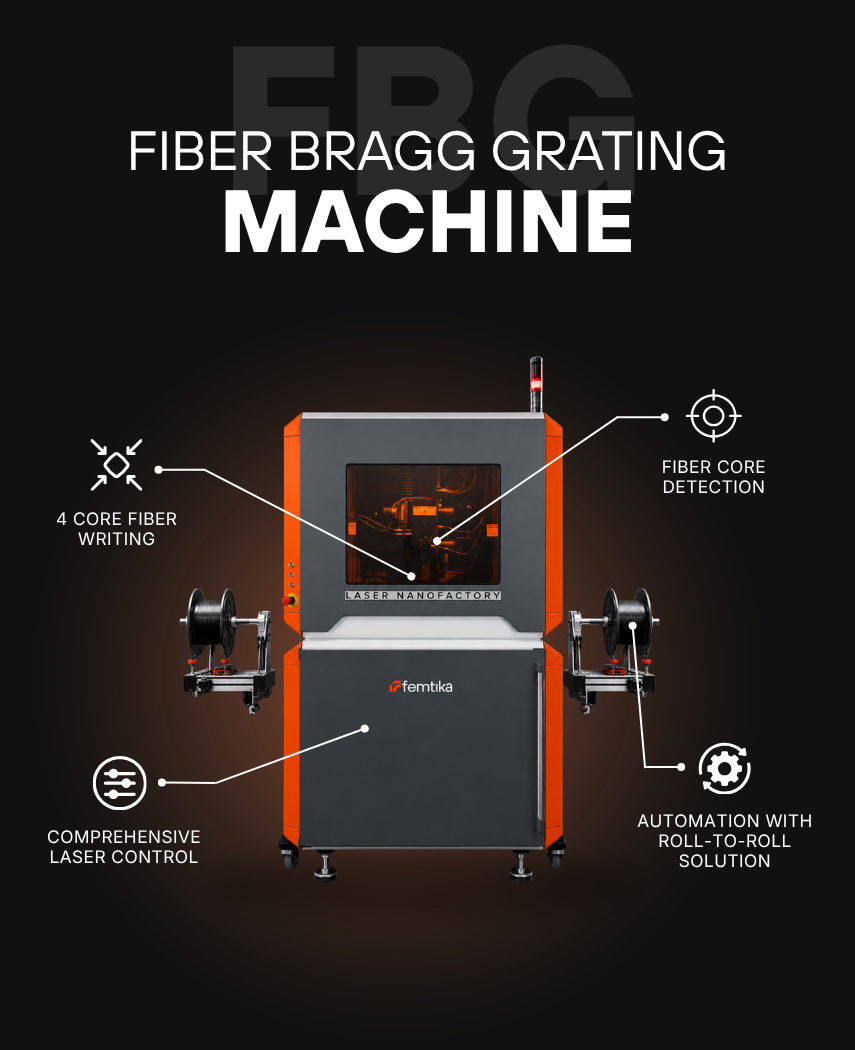
Fiber Bragg Grating Machine — an advanced version of the Laser Nanofactory, built for optical communication and fiber processing, using a roll-to-roll mechanism to write gratings directly inside the fiber on an industrial scale.
Contract Manufacturing Services (CMS) — batch production of 3D glass micro-parts, using the same femtosecond laser machines we build.
The Freedom to Innovate with Transparent Materials
Our aim is to make this once hard-to-reach SLE technology accessible to engineers and organizations worldwide. We are giving those who once found true 3D micro-structuring of transparent materials out of reach — the freedom to innovate.
Femtika makes this possible. Our machines and contract manufacturing services give science and industry the ability to process transparent materials with:
- Micron-scale precision — surface roughness down to 200 nm and features down to 5 microns, achieved without mechanical contact, so even delicate transparent materials are processed crack-free
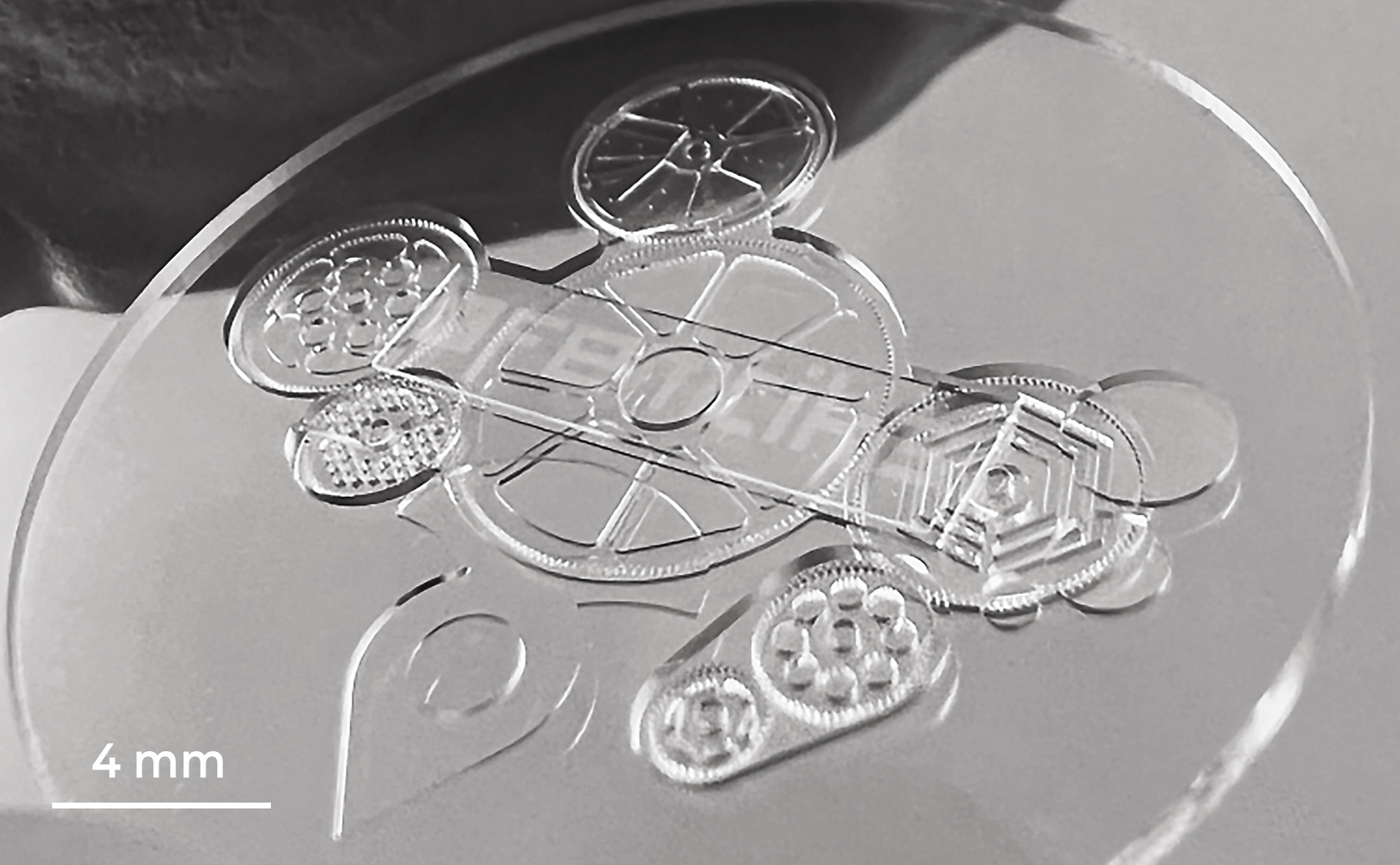
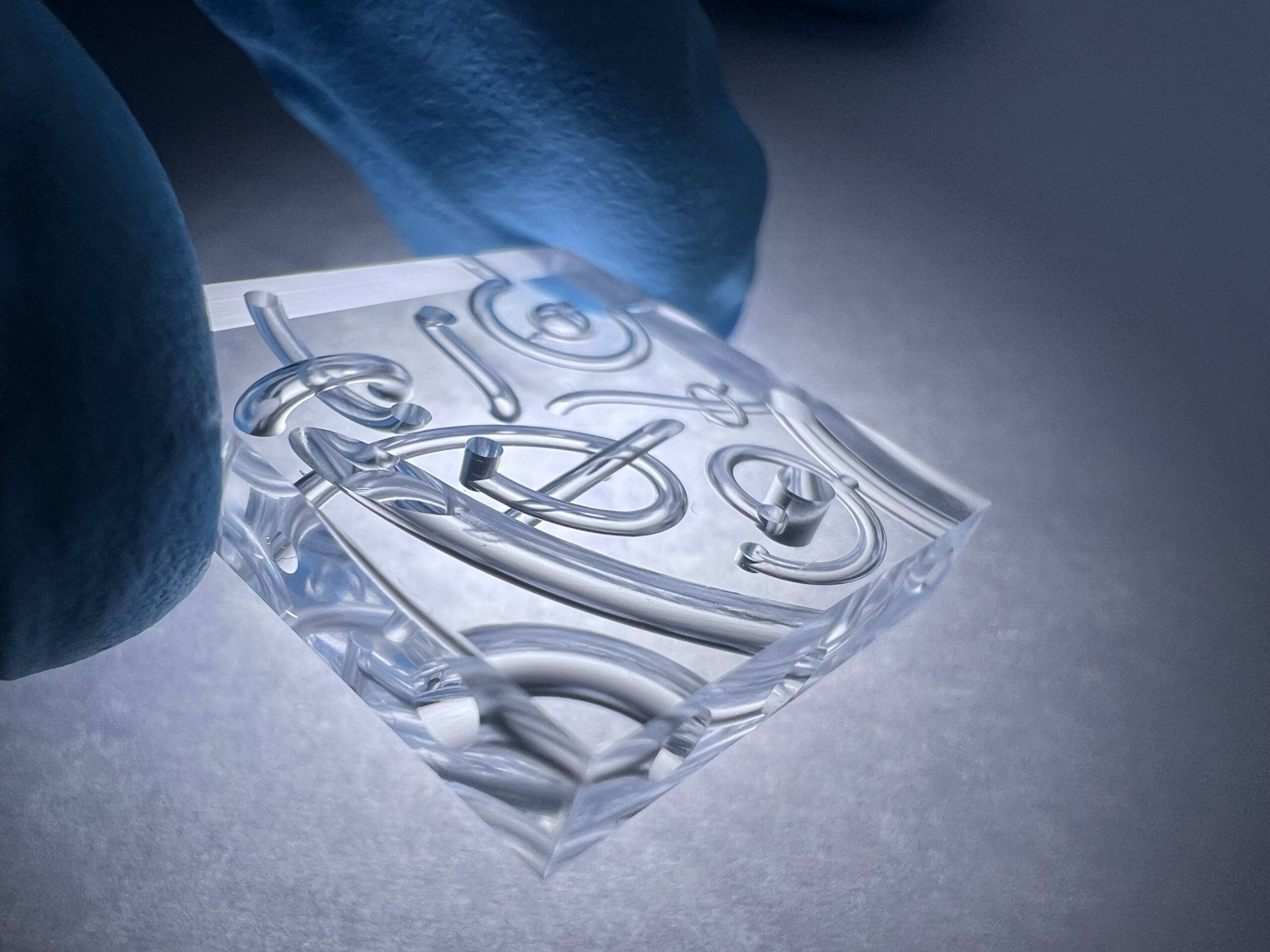
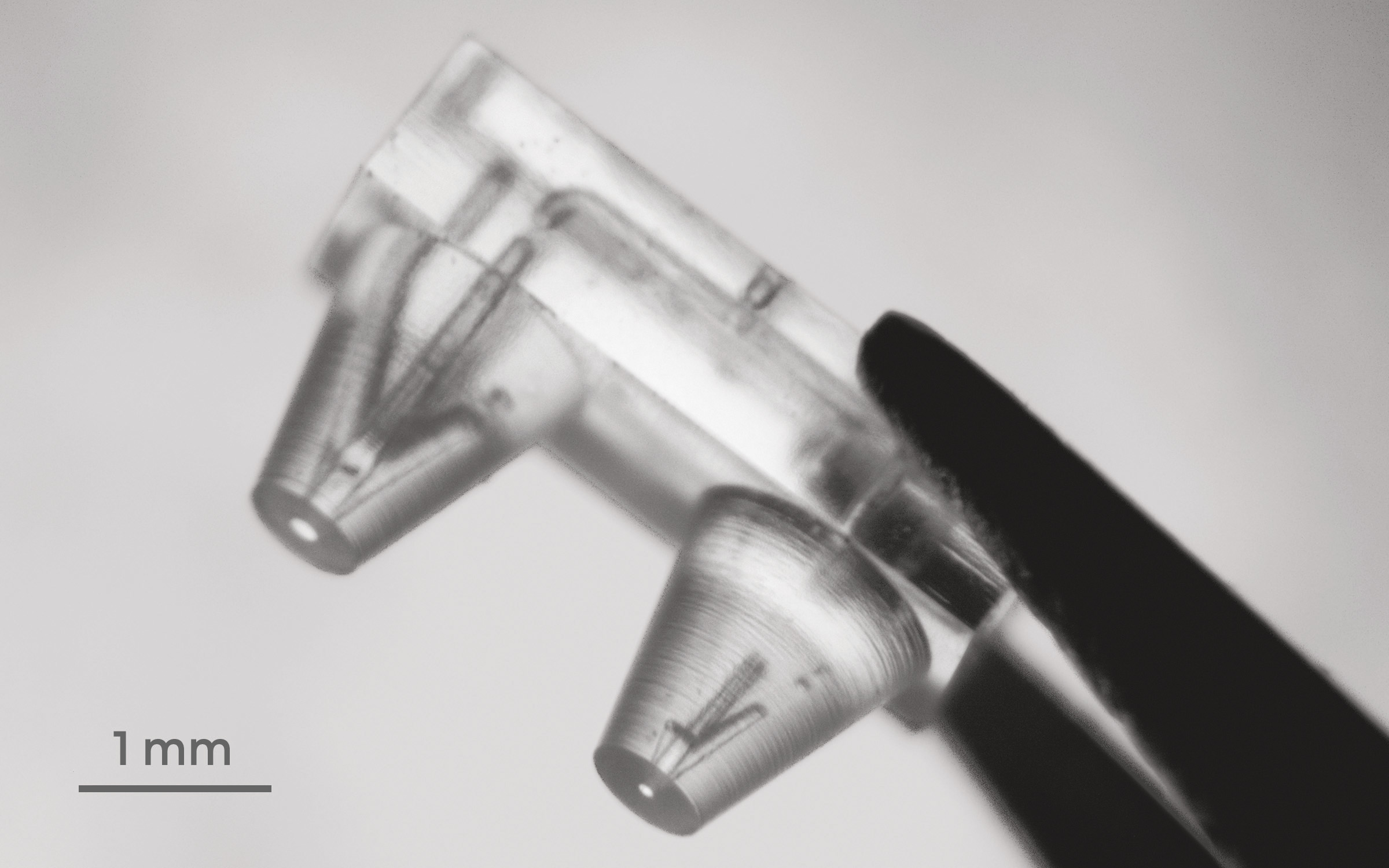
- True 3D freedom — internal channels, embedded structures, and free-form geometries created from, on, and inside the material
- Thick materials — processing depths of up to 2 cm in glass thickness, enabling complex, high-aspect-ratio structures in a single piece of transparent material
- Clean, distortion-free results — femtosecond pulses modify the material with virtually no heat spread, preserving sharp edges and fine detail at micro-scale
- Consistent, repeatable production — once a process is developed, it scales reliably from prototype to production volume
The capabilities SLE provides are remarkable. It can be used across a wide range of industries and applications that depend on transparent materials performing at the micro-scale and matching the precise requirements each one demands:
- Microfluidics and micro-devices — internal channels and free-form geometries for cell sorting, droplet generation, organ-on-chip systems, and point-of-care diagnostics.
- Biotech and life sciences — bio-compatible, optically transparent components for diagnostic and analytical instruments.
- Photonics and optical communication — precision fiber alignment structures and embedded Fiber Bragg Grating components.
- Semiconductors — Through-Glass Vias (TGV) and high-precision substrates
- Micro-mechanics and micro-robotics — gears, bearings, nozzles, and moving parts machined directly from transparent materials.
- Watchmaking and luxury goods — transparent components with complex internal geometries and decorative detail.
- Scientific research — rapid prototyping of custom 3D microstructures for novel experimental setups.